Current Edition |
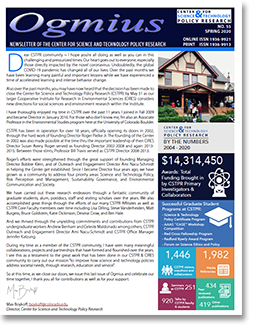 |
No 55, Spring 2020
- Ecological Economics, Dangerous Ideas and Academic Freedom by Matt Burgess
- Crisis Response and the Standing of Expert Knowledge by Steve Vanderheiden
- Making Learning by Governments More Common – What Disaster Research Tells Us About the U.S. COVID-19 Case by Deserai Crow
- Steal This Joke: Uplifting Climate Comedy Celebrates Earth Day 2020 by Beth Osnes
- Homeward Bound: Learning Leadership in and from Antarctica by Cassandra Brooks
- Tomorrow: Sharing Stories of the COVID-19 Experience ... From Quarantine by Daniel Zietlow
- Victory is Won Through Many Advisers: Rad Byerly and the Radford Byerly, Jr. Award by Alison Gilchrist
- #Makingourcase: Science Has a Place in Policy by Spencer Zeigler
|
| |
Previous Editions |
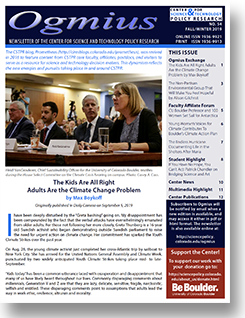 |
No 54, Fall/Winter 2019
- The Kids Are All Right Adults Are the Climate Change Problem by Max Boykoff
- The Non-Partisan Environmental Group That Will Make You Feel Hopeful by Alison Gilchrist
- CU Boulder Professor and 100 Women Set Sail for Antarctica
- The Endless Hurricane: Documenting Life in the Shelters After Maria by Fernando Briones
|
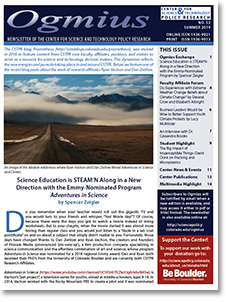 |
No 53, Summer 2019
- Science Education is STEAM’N Along in a New Direction with the Emmy-Nominated Program Adventures in Science by Spencer Zeigler
- Do Experiences with Extreme Weather Change Beliefs about Climate Change? Perhaps, If your Neighbors are Harmed by Deserai Crow and Elizabeth Albright
- Business Leaders Would be Wise to Better Support Youth Climate Protests by Lucy McAllister
|
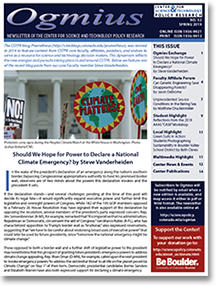 |
No 52, Spring 2019
- Should We Hope for Power to Declare a National Climate Emergency? by Steve Vanderheiden
- Can Genetic Engineering Save Disappearing Forests? by Jason Delborne
- Unprecedented Sea-ice Conditions in the Bering Sea by Matthew Druckenmiller
- Green Suits in Action: Students Photographing Sustainability in BVSD by Beth Osnes
|
 |
No 51, Fall/Winter 2018
- Elon Musk Deserves the Nobel Peace Prize by Matt Burgess and Ian Burgess
- Into the Wild – For Rain, Part I. British Columbia by Eve-Lynn Hinckley
- Reconciling the Supply of and Demand for Research by Roger Pielke, Jr.
|
 |
No 50, Summer 2018
- The Complexity of Consensus: Protecting the World’s Most Remote Ocean by Cassandra Brooks
- Learning from Colorado’s 2013 Floods by Deserai Crow and Elizabeth Albright
- A More Effishient Way to Conserve Forests and Support Livelihoods? by Peter Newton
|
 |
No 49, Spring 2018
- Tax Reforms, Tuition Waivers, Role of Policy-Relevant Knowledge Production by Steve Vanderheiden
- On the Ground Learning: Law Students Travel the Colorado Plateau by Alice Madden
- CSTPR’s Fulbright Visiting Scholar: Anna Kukkonen
|
 |
No 48, Fall/Winter 2017
- The 15th Anniversary of CSTPR: Science and Technology Policy Research in a Unique Space
- Pointing to the Thawing Arctic, Scientists Spend a Week in Washington, DC by Matthew Druckenmiller
- Environmental Communication and the Public Sphere in Shanghai by Phaedra C. Pezzullo
|
 |
No 47, Summer 2017
- Why Can’t We All Just Get Along? Collaborative Governance on the Colorado River by E. Koebele
- Navigating With Intention: CSTPR Alumnus Bets Mcnie Talks About Her Career and Future
- A Fork in the Road: Jack Stilgoe Considers the Future with Self-Driving Cars
|
 |
No 46, Winter 2017
- Priority Schemes for Water Allocation in Australia and the Netherlands by Steve Vanderheiden
- Founder of OpenSnow Creates 14er Forecast App
- Scientists Informing Congress: How Julia Schubert Uses Geoengineering Policy as a Case Study
|
 |
No 45, Fall 2016
- 2017 Radford Byerly, Jr. Award in Science and Technology Policy
- Prometheus, Past and Present
- How Do Science and Technology Affect Policymaking?
|
 |
No 44, Summer 2016
- Social-Impact Network” For Wildfire Adaptation by Dan Zietlow
- Environmental Rights and Adaption to Climate Change by Dan Zietlow
|
 |
No 43, Spring 2016
- CSTPR Welcomes Max Boykoff as Director by Dan Zietlow
- Research Highlight: Climate Change in an Amazon Town by Sam Schramski
|
 |
No 42, Fall 2015
- Beyond the Chief Scientific Adviser by Dr. Jan Marco Müller
- Research Highlight: Individual Drivers for Environmental Engagement by Gesa Luedecke
|
 |
No 41, Summer 2015
- The Postmodern Prometheus by Dr. Jack Stilgoe
- Research Highlight: Research on Emissions, Air Quality, Climate, and Cooking Technologies in Northern Ghana by Katie Dickinson
|
 |
No 40, Spring 2015
|
 |
No 39, Fall 2014
- Red Cross/Red Crescent Climate Centre Internship Program
- Research Highlight: Is Climate Journalism Becoming More Cautious? Maybe So
|
 |
No 38, Spring 2014
- STePPS: Science, Technology, Policy and Politics of Sport by Roger Pielke, Jr.
- Research Highlight: The Dynamics Of Vulnerability - Rethinking Our Approach to Drought in the Face of Climate Change by Dan Zietlow
|
 |
No 37, Winter 2013/2014
- September 2013 Floods In Colorado’s Front Range by Nolan Doesken and Klaus Wolter
- Research Highlight: Fire And Flood - Understanding How People, Governments, And Specific Communities Respond To Extreme Events by Deserai Anderson Crow
|
 |
No 36, Fall 2013
- Interview with Roger Pielke, Jr
- Research Highlight: Red Cross/Red Crescent Climate Centre Internship Program
|
 |
No 35, Spring 2013
- Power Politics: The political ecology of wind farm opposition in Wyoming by Shawn Olson
|
 |
No 34, Fall 2012
- International Conference on Culture, Politics & Climate Change by Deserai Crow
- Research Highlight: The Normative Dimensions of Climate Change by Benjamin Hale
|
 |
No 33, Summer 2012
|
 |
No 32, Winter 2012
- Freshwater Use by U.S. Power Plants: Initial Insights Into the Energy-Water Nexus by Kristen Averyt
- Research Highlight: Characterizing, Creating, and Governing Florida’s Hurricane Risk by Jessica Weinkle
|
 |
No 31, Fall 2011
- Science For Climate Adaptation: Reflections from Behind the 8 Ball by Susanne C. Moser
- Research Highlight: Analyzing Expressed Stakeholders Needs in the Western Water Assessment Region by John Berggren and Lisa Dilling
|
 |
No 30, Spring 2011
Two Decades and Two Adaptation Panels: What Progress? by William R. Travis
Research Highlight: Science Informing Policy? Understanding Drivers and Constraints to Improved Water Management in a Changing Climate by Christine Kirchhoff and Lisa DIlling |
 |
No 29, Winter 2011
- Snowmageddon Policy and Politics by William R. Travis
- Research Highlight: Media and Climate-Related Responsible Behavior
|
 |
No 28, Summer 2010
- Rethinking Climate Policy by Roger Pielke, Jr.
- Research Highlight: Colorado Climate Preparedness Project
|
 |
No 27, Spring 2010
- Reflections of a Former Graduate Student by Nat Logar
- Life After CSTPR by Shep Ryen
- Research Highlight: Science Policy for Decision Making
|
 |
No 26, Fall 2009
- Emergency Use Only: Geo-engineering to Reduce Global Warming by William Travis
- Research Highlight Discursive Stability Meets Climate Instability: A Critical Exploration of the Concept of
- ‘Climate Stabilization’ in Contemporary Climate Policy by Max Boykoff
|
 |
No 25, Summer 2009
- A Brief Report from a Workshop on Science Policy Research and Science Policy Decisions by Roger Pielke, Jr.
- Research Highlight "Climate Change Metrics and Their Uncertainty" by Ursula Rick
|
 |
No 24, Winter/Spring 2009
- Air capture: The latest distraction? by Paul Komor
|
 |
No 23, Fall 2008
- An Interview with the New CSTPR Director, Bill Travis
|
 |
No 22, Summer 2008
- A caution to policy makers: Climate models fail key tests for accuracy by Tom Chase
- Responses by Kevin Trenberth, Mike Hulme and Roger Pielke, Jr.
|
 |
No 21, Winter 2008
- Something to Talk About: Rethinking Communication and Climate Change by lisa Dilling
- Research Highlight "The Ecology of Organizations in Greater Yellowstone" by David Cherney
|
 |
No 20, Fall 2007
- Mother Gruesome’s Nursery by Benjamin Hale
- Research Highlight "The Influence of Climate Change on the Functioning of Water Rights"
|
 |
No 19, Summer 2007
- Can a concept (World Heritage Status) Save a Sea (the Aral Sea)? by Mickey Glantz
- Research hHghlight "Research for benefit in federally funded mission agencies" by Nat Logar
|
 |
No 18, Winter/Spring 2007
- Apocalypse Soon: Climate Change, the End of Oil, and the Perils of limiting Choices by Frank Laird
- Research Highlight "Massachusetts v. EPA: Who Should Run the Greenhouse?" by Marilyn Averill
|
 |
No 17, Fall/Winter 2006
- Arbitrary Impacts and Unknown Futures: The shortcomings of climate impact models by Ryan Meyer
- Research Highlight "The Challenges Facing Homeland Security S&T" by Shali Mohleji
|
 |
No 16, Summer/Fall 2006
- Transitions by Kevin Vranes
- Research Highlight, "Co-producing useful information for climate policy: Informing science policy research for improved decision-support" by Elizabeth McNie
|
 |
No 15, Spring 2006
- Reproductive medicine, politics and religion in Italy: Reflections on the 2005 referendum by Gilberto Corbellini
- Visiting Scientist Perspective by Melanie Roberts
|
 |
No 14, Winter 2006
- Science Policy: The year ahead by David Goldston
|
 |
No 13, Fall 2005
- Katrina, Acts of God, and Acts of People by Roger Kennedy
|
 |
No 12, July 2005
- Science Policy: The Victim of Partisan Politics by Robert Palmer
|
 |
No 11, April 2005
- Of Mice and Men: The Endangered Species Act and Preble’s Meadow Jumping Mouse by Anne Ruggles
|
 |
No 10, January 2005
- Science, Genetically Modified Foods, and the Rumsfeld Doctrine by Michael Rodemeyer
|
 |
Number 9, September 2004
- Addressing the Under-representation of Women in the Sciences by Patricia Rankin
|
 |
Number 8, May 2004
- The Cherry Pick by Roger Pielke, Jr.
|
 |
Number 7, January 2004
- Governmental Responses to Cybersecurity Breaches by Phil Weiser and Douglas C. Sicker
|
 |
Number 6, October 2003
- Good for the Goose by Roger A. Pielke, Jr.
- Response to Clark and Pulwarty’s “Devising Resilient Responses to Potential Climate Change Impacts” by Suraje Dessai
|
 |
Number 5, May 2003
- Devising Resilient Responses to Potential Climate Change Impacts by Martyn Clark and Roger Pulwarty
- Response by Rob Wilby
|
 |
Number 4, January 2003
- Humanities for Policy - and a Policy for the Humanities by Robert Frodeman and Carl Mitcham
- Response by Malcolm Richardson
|
|
Number 3, October 2002
- Thoughts on Catastrophic Terrorism in America by Lewis M. Branscomb with response by Eugene Skolnikoff
|
 |
Number 2, May 2002
- The Data Quality Act: A New Tool for Ensuring Clarity at the Interface of Science and Policymaking by Jim J. Tozzi
- Response by Chuck Herrick
|
 |
Number 1, January 2002
- Comments on Improving Science and Technology Advice for Congress by Radford Byerly
- Response by M. Granger Morgan.
|



 cstprinfo@colorado.edu


