|
This project is aimed at developing a comprehensive understanding of the use of information by stakeholders of the NOAA/NWS Colorado Basin River Forecast Center (CBRFC). Through surveys and interviews, the researchers will assess the climate information needs of CBRFC stakeholders and how they do or do not use quantitative streamflow forecasts. This will provide 1) a better understanding of how water managers and others who use CBRFC forecasts deal with variability and 2) a context through which to view and understand the potential utility of the results of the “Snowmelt Perturbations in the Upper Colorado River Basin” project. |
|
ASPEN focuses on weather policy research, education, and outreach. |
|
|
By comparing the supply and demand sectors of carbon cycle science, Carbon Cycle Science will assess where linkages between the sectors are strong and where missed opportunities for linkage exist |
|
|
Max Boykoff examined climate adaptation strategies in urban environments (with Dr. Emily Boyd, Leeds University). In this project they have focused on adaptation to flood events in Mumbai, India, and compare particular events in recent years to flooding in urban areas of the UK, and associated adaptive strategies. This project links with some of Max’s past research that has examined vulnerability and livelihood issues in relation to global climate change and extreme events in Honduras. |
|
This NOAA-funded project examined the potential for carbon management through land use decision making in Colorado. Previous work has focused on the technical potential of vegetation or the economic incentives necessary to induce stakeholders to change practices, but thus far there has not been a focus on the ownership pattern across the landscape, and how it might affect whether the potential for additional carbon sequestration on land might be realized. |
|
Lisa Dilling, Jason Neff, Jana Milford and Nichole Barger are pursuing an integrated multi-scale approach to the evaluation of carbon stocks and fate under different management on public lands in the Intermountain West |
|
An interdisciplinary approach to position CU Boulder as a leader in adaptive biogeochemical management of federal rangelands and forests. Working with the San Juan Public Lands Center, Jason Neff and others have developed a carbon research plan intended to make Southwest Colorado a demonstration site for potential federal carbon management policy. The project’s goal is to initiate a joint federal/CU effort to design protocols for, and evaluate the implications of, emerging carbon management plans. |
|
On April 4, 2006, the Western Water Assessment (WWA) sponsored a symposium titled "Coping with Climate Change: A Symposium Highlighting Activities at the University of Colorado to Help Decision Makers Prepare for the Future." The purpose of the symposium was to identify and highlight research and other activities at the University of Colorado designed to assist decision makers in responding to and coping with the coming impacts of climate change. |
|
|
The Climate Services Clearinghouse draws together climate services and products across sectors, from NOAA, non-NOAA government agencies, academia, and the private sector. As a result, it enables providers to identify and fix overlap and gaps in existing services. It also enables site visitors to locate any service of interest. |
|
This Western Water Assessment-funded project addressed the state of Colorado’s progress toward the Governor’s goal of preparing the state to adapt to unavoidable climate change. The primary purpose is to set the stage for the next governor to continue to plan for climate variability and change by providing a catalog of climate vulnerabilities and current activities, personnel, products, and projects from Colorado and other entities along with policy relevant, but not prescriptive, suggestions for future actions. |
|
The Committee on Environmental Thought (ComET) is an environmental theory research group located at the University of Colorado, Boulder. The Committee was initially convened by Professor Benjamin Hale in early 2010 as a means of collaborating on projects related to environmental theory. Members of the group seek to investigate and explore environmental problems and the normative presuppositions that inform, frame, and guide solutions to these problems. |
|
|
The goals are to take stock of what is known in pertinent fields and identify the connections between them. Specifically we will foster communication across the disciplinary, paradigmatic and academic/praxis lines in order to push forward our research agenda and to delineate the state-of-the-art and developing a research and action agenda within the context of climate change. |
|
The Farm Adapt Model simulates yield, costs, and outputs of a 2,000 acre dryland wheat farm on the U.S. Great Plains, with the goal of modeling the impacts of climate variation, especially extreme events and rapid climate change, and farmer adaptation. Climate change is input via off-sets to the mean of the yield distribution from which the farm draws each year in a 30 year simulation. |
|
Ben Hale’s research explores the ethics of climate change responses: Geoengineering, Ocean Fertilization, and the Problem of Permissible Pollution; Science, Technology and Human Values; Getting the Bad Out, The Environment; Non-Renewable Resources and the Inevitability of Outcomes; and Private Ownership and Moral Jurisdiction. |
|
Since 2002 the Center has undertaken a series of Western Water Assessment-funded projects focused on drought, climate change, and water institutions. In its "Impact of Earlier Spring Snowmelt on Water Rights and Administration" project the Center examined whether the mismatch between seasonal water rights and earlier runoff in the Intermountain West has resulted in conflict between supply and demand. Earlier work analyzed the drought coping mechanisms of several Colorado Front Range water providers. |
|
This Western Water Assessment-funded project, “A Drought Impact and Vulnerability Indicator Suite” led by Center director Bill Travis with research assistant Kristin Gangwer, has spent the past year creating a set of indicators for assessing the impacts of drought across different sectors (urban, agricultural, water, recreation), with the goal of developing both research-quality time series that can be normalized and analyzed for trends, and applied indicators that can help managers assess impacts and changing vulnerabilities. |
|
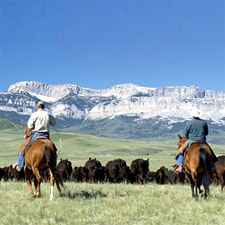
Ranchers in the Rocky Mountain West navigate a complex land-tenure system comprised of deeded, leased, and public grazing lands. Droughts create management challenges for ranchers across their land holdings and impose physical, social, and economic impacts on the ranching system. However, while some studies have explored western ranchers’ drought experiences and management strategies, none have looked specifically at the role land tenure plays in their drought responses, and most literature on the relationship between land tenure and drought has thus far focused outside the United States. |
|
This NSF-funded joint project between Northern Arizona University, the University of Montana, and the University of Colorado at Boulder aims to develop educational resources that will enable graduate students in the natural sciences to develop the fundamental skills needed to navigate the intersection of ethics, public policy, and environmental science. |
|
The rulemaking process has become central to policymaking over the past several decades, with a large portion of regulatory authority delegated to administrative agencies. This is increasingly so in a federal system defined by political gridlock, wherein much of the policymaking occurs at the state and regulatory levels. Regulation consists of “an array of public policies explicitly designed to govern economic activity and its consequences at the level of the industry, firm, or individual unit of activity”. State-level bureaucratic agencies are not elected, and as a result, states have developed processes to incorporate input from regulated communities and other parties potentially affected by proposed regulations. |
|
Graduate student Gene Longenecker and Bill Travis are studying the possibility that some responses to natural hazards increase losses in the long run. They are using the latest hazard loss simulation model to test ways in which this effect could be detected. |
|
|
The Extreme Weather Sourcebook contains economic and other societal impacts related Hurricanes, floods, tornadoes, lightning, and other U.S. weather phenomena. |
|
|
The Flatirons Outdoor Classroom is a K-12 curricular project involving the Boulder Valley School District, the Denver Museum of Nature and Science, and the University of Colorado. The Project consists of an interdisciplinary outdoor learning environment that combines elements of science, art, social studies, and the humanities, and a forthcoming suite of curricular materials designed to make effective use of the classroom. |
|
Flood damage has increased in the United States, despite local efforts and federal encouragement to mitigate flood hazards and regulate development in flood-prone areas. To help researchers and policy makers assess national progress in reducing vulnerability to flood hazards, reasonably accurate assessments of flood damage are needed. Yet, accurate accounting for losses has historically received little attention, except in the case of insured property. The flood damage estimates presented in this website are compiled from NWS
records and publications, supplemented by reports of other federal and
state agencies. The accompanying report includes an evaluation of the
accuracy of the estimates and recommendations for users of the data. |
|
|
|
GCCS consists of three program leaders (a philosopher, an atmospheric scientist, and a policy scientist), several internship mentors, and twelve students, the latter drawn from the physical sciences, the social sciences, and the humanities. Students explore the nature of scientific knowledge--its epistemological character, and its social and philosophic implications--and the contribution that social scientific and humanistic perspectives play in public policy debates. |
|
Lisa Dilling is collaborating with graduate student Rachel Hauser on an effort to look at analogs from other areas of research to understand under what circumstances we might want to apply extra scrutiny to proposed geo-engineering research and for what reasons. |
|
|
Humanities in the Parks proposes to place graduate students in the humanities (e.g., literature, history, philosophy, religious studies, fine arts) within various units of the National Park Service for periods of 12 to 14 weeks. |
|
|
Humanities policy can make significant contributions to areas such as nanotechnology, homeland security, and global environmental change--in fact, in any area where science and technology intersect with broader societal interests. |
|
|
In this project ENVS graduate student Edouard von Herberstein proposes a method to assess the sensitivity of insurance pricing methods to data quality and questions whether these pricing techniques efficiently use the information in hurricane loss models. |
|
|
The central theme of Hydro-Climate Research and Decision Making is to advance hydro-climate research to meet the decision-making needs of water managers in different parts of the country. |
|
|
The Klamath Basin Project focuses on the use of science and its relation to policy conflicts regarding water and fish in the Klamath Basin since 2001. |
|
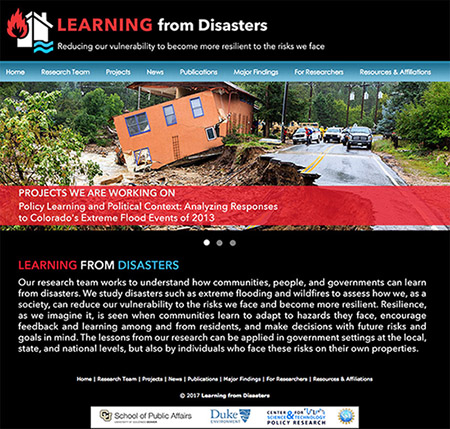
Understanding how local governments respond to a disaster and plan for the future is critical to consider in order to determine whether experiencing a disaster results in safer and more resilient communities. Our work is focused on what leads to increased community resilience to future disasters. We have spent the last four years focused on understanding how communities, the public, and governments can learn from disasters. |
|
|
The goal of this project is to evaluate the policy processes and outcomes related to the Public-Private-Academic Partnership on Level II Radar Data January-December 2005. |
|
|
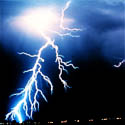
This research project by graduate students Joel Gratz and Erik Noble explores policy options for large outdoor stadiums to protect spectators from lightning strikes. |
|
The project is examining sense-making around climate engineering in four different countries (the United States, Japan, New Zealand, and Sweden are currently included in the study). |
|
|
The Center for Nanotechnology and Society (CNS-ASU) is working side by side with scientists who are making nanotechnology a reality to anticipate and understand the societal consequences of this new area of innovation. |
|
Addressing public policy problems in an increasingly complex world relies heavily on communication, interpretation, and use of information. Media are one primary source through which information is disseminated, consumed, and framed. Media are frequently referenced in the policy literature as important mechanisms for policy change, a tool through which stakeholders influence policy outcomes, or a measure of policy agendas. |
|
|
A truly interdisciplinary approach to environmental problems, developed though institutional and curricular programs nationwide. |
|
|
"Our Science Their Science" aims to enhance the understanding of the interplay of science, culture, power and politics in international affairs through a focus on the Large-Scale Biosphere Atmosphere experiment. |
|
With Elizabeth Albright, a colleague at Duke University, Deserai Crow is working to understand the policy responses in the aftermath of the September 2013 floods along Colorado’s Front Range. Understanding the factors that encourage policy learning and adaptation in local policy contexts may prove critical, since this can mean the difference between ongoing flood vulnerability as a consequence of extreme weather events rather than long-term resilience. |
|
To gain perspective on the role of science in policy and politics at the highest levels of government, the CIRES Center for Science and Technology Policy Research sponsored a lecture series in 2005 - 2006 featuring current and former presidential science advisors. |
|
|
The workshop was organized to bring together people who have expertise in both the scientific and policy aspects of relevant case histories, plus several discussants with general insight into the issue. The goal of the meeting was aptly reinforced by one participant who noted the contrast between the depth to which policy makers rely on predictions versus the lack of depth in society's understanding of the consequences of that reliance. |
|
|
We are investigating the role of prediction in the making of environmental policies. Such policies relate to problems that include: planning for and responding to natural hazards (weather, floods, earthquakes, asteroids); planning for and responding to anthropogenic hazards (global climate change, acid rain, nuclear waste); managing natural resources (oil reserves, beaches); and regulating environmental impacts (mining). |
|
While cleaner-burning stove technologies have potential health, environmental, and social benefits, efforts to disseminate these technologies have fallen short and the practice of cooking with biomass over open fires remains dominant throughout much of the developing world. The central aim of the P3 project is to study factors influencing adoption of improved cookstoves in Northern Ghana. |
|
|
Prometheus provides daily news and commentary on science policy issues. |
|
|
RAA-CU-NCAR Joint Internship Program. The Reinsurance Association of America and the University of Colorado announce a summer internship program for graduate students in science, engineering or policy. The goal of this program is to give students an opportunity to learn about and gain experience in a major global industry that relies on scientific and engineering expertise. |
|
Reconciling the Supply of and Demand for Research in the Science of
Science and Innovation Policy Workshop, 12-14 May 2009, Oslo, Norway. This
workshop brought together academics, practitioners, and those with feet
in both worlds to examine how science policy research does (or does not)
support the information needs of science policy decision makers. Highlights from the workshop findings will be published as a Policy Sciences Special Issue in 2011. |
|
|
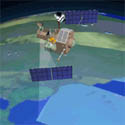
The goal of the workshop was to provide a comprehensive assessment of the risks and benefits associated with the decision alternatives the agency faces with respect to TRMM. |
|
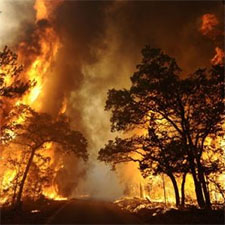
Wildfire has long existed as a natural component of an ecosystem. However, due to many years of fire suppression policy alongside increasingly dry conditions, the western United States is experiencing some of the biggest and most severe wildfires in history. In recent years, fires affecting populations along the wildland-urban interface (WUI) have grown in size and destruction, substantially impacting life and property across the West. Western states are experiencing significant population growth and development combined with prolonged drought conditions and predictions of climate change that indicate increasing drought in the West. |
|
|
This project examines the relationship of scales in carbon cycle science to scales needed for decision-making. |
|
Each day, in the face of deep uncertainty, millions of decisions are made that respond to and influence the behavior of climate. How does the nation's multi-billion dollar investment in climate research affect those decisions? How can the societal value ofthis scientific investment be enhanced? These are the core organizing questions for the NSF-funded project, Science Policy Assessment and Research on Climate (SPARC). |
|
The Center hosted an all-day symposium on Science, Technology, and Decision Making on February 25, 2005. The symposium featured presentations by graduate students and faculty members about science and technology policy-related activities at the Center and on the CU campus. |
|
STePPS is a new project of the CIRES Center for Science and Technology Policy Research. It is focused on the governance of sport, with a special emphasis on the roles of science and technology in how sport is governed. STePPS will focus on original research, university education and outreach to the broader community. We have partnered with the emerging undergraduate certificate program in Critical Sports Studies, out of the Department of Ethnic Studies. |
|
|
Organized by the CIRES Center for Science and Technology Policy Research, our Fall 2002 Symposium sought to foster new connections and dialogue among decision makers and scientists from institutions along the Colorado Front Range. The Symposium brought together national and local experts to discuss topics such as computer security, bioterrorism, water security, support for homeland defense and emergency management. |
|
|
A portal connecting you to information on how severe weather affects society. |
|
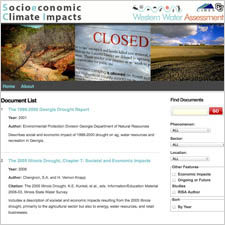
This project entailed the creation of an online, searchable database of research on socioeconomic impacts of climate change in the Intermountain West. It has been populated with over 200 items, including peer- and non-peer-reviewed articles, reports, websites, presentations, etc. addressing the socioeconomic impacts of various climate phenomena. |
|
|
The State of the Carbon Cycle Report (SOCCR) is a broadly conceived activity "designed to provide accurate, unbiased, and policy-relevant scientific information concerning the carbon cycle to a broad range of stakeholders." The two overarching objectives for the SOCCR are to summarize scientific knowledge about carbon cycle properties and changes, and to provide scientific information for decision support and policy formulation concerning carbon. |
|
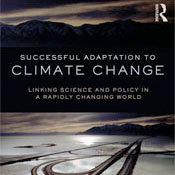
What does successful adaptation look like? This is a question we are frequently asked by planners, policy makers and other professionals charged with the task of developing and implementing adaptation strategies. While adaptation is increasingly recognized as an important climate risk management strategy, and on-the-ground adaptation planning activity is becoming more common-place, there is no clear guidance as to what success would look like, what to aim for and how to judge progress. This edited volume (Susanne Moser and Maxwell Boykoff) makes significant progress toward unpacking the question of successful adaptation, offering both scientifically informed and practice-relevant answers from various sectors and regions of the world. |
|
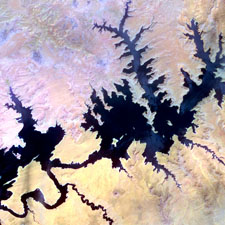
Together with the Great Lakes and Carolinas RISAS, this Western Water Assessment-funded project has developed a database of stakeholder needs across the Colorado River Basin from past and current stakeholder reports, meetings, and studies, coding the information for variables of interest and developing a comprehensive framework that can be accessed and tested by other RISAs and assessment groups. |
|
|
The thirtieth anniversary of Camille's landfall presents an opportunity to raise the issue of a national hurricane policy and to assess what has been learned in the three decades since. |
|
In this project post doc Christine Kirchhoff has examined how climate-related information is used in water management contexts across vertical scales, as well as in different contexts across comparable horizontal scales. She asked questions about how information is selected, what types of information is currently demanded, how information flows across scales, how trust factors into information use, and the like. |
|
Lisa Dilling is co-lead this WWA-funded project to investigate why some local decision makers choose to adapt to climate-related stress and risk while others do not. Their idea was to systematically investigate the conditions under which local decision-makers in cities and large towns in Colorado, Utah, and Wyoming decide to adapt (or not) to increased climate-related risk and hazards. |
|
|
Use and Value Bibliography. |
|
|
WeatherZine is a bimonthly newsletter on the societal aspects of weather. It contains opinion pieces, news, and a brief summary of developments at the Societal Aspects of Weather Web site. |
|
|
The mission of the Western Water Assessment is to identify and characterize regional vulnerabilities to climate variability and change, and to develop information, products and processes to assist water-resource decision-makers throughout the Intermountain West. |
 Atmospheric Sciences Policy Education and Network
 Carbon Cycle Science: Reconciling Supply and Demand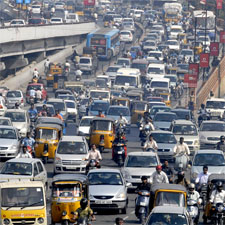
 Carbon Management on Public Lands

 ComET: The Committee on Environmental Thought
 Decision Models
 Dialing Down: Undoing the Climate Damage
 Drought Vulnerability Indicators Project
 Dryness and Desperate Measures: The Implications of Land Tenure on Rocky Mountain Ranchers' Drought Experiences and Behaviors
 Ethics, Public Policy, and Environmental Science
  E
E Extreme Events: Agents of Adaptation






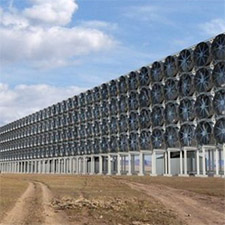

 Narratives, Media, and Issue Framing in Environmental Policymaking

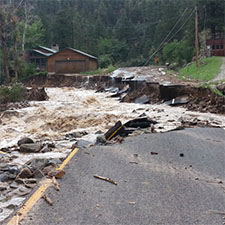 Policy Learning and Political Context: Analyzing Responses to Colorado’s Extreme Flood Events of 2013




 Risk Perceptions and Support for Management Regimes in Wildland-Urban Interface Zones: A Comparative Analysis of Wildfire Policy and Citizen Response in the Intermountain West
 Science Policy Assessment and Research on Climate


 A Socioeconomic Impacts and Adaptation Strategies Clearinghouse
 Successful Adaptation to Climate Change: Linking Science and Policy in a Rapidly Changing World
 Toward a Framework for Assessing Stakeholder Needs for Climate Information
 Understanding Demand for Climate Adaptation Information Across Scales
 Understanding the Drivers of Adaptation at the Municipal Level in CO, WY and UT



 cstprinfo@colorado.edu


