
Vision
To serve as a resource for science and technology decisions and those providing the education of future decision makers.
Mission
To improve how science and technology policies address societal needs, through research, education and service.
 FAQ (below)
Who We Are, What We Do
The Center for Science and Technology Policy Research (CSTPR) was initiated within the Cooperative Institute for Research in Environmental Sciences (CIRES) at the University of Colorado-Boulder in the summer of 2001 and was recognized as an official University center in the summer of 2002 as a contribution both to the CIRES goal of “promoting science in service to society” and to the University’s vision of establishing research and outreach across traditional academic boundaries.
CSTPR seeks to improve how science and technology policies address societal needs, through research, education and service.
The Center is a response to an increase in problem-focused research at the interfaces of environment, technology, and policy, and to the growing demand by public and private decision makers for “usable” scientific information. Our work is often aimed at understanding the choices that people and institutions make in pursuing goals under uncertainty, be it an uncertain future climate, uncertain outcomes of investments in science and technology, or the uncertain outcomes of a particular environmental policy. One of our goals is enlarging the range of choice considered by policy-makers, by analyzing options in areas such as energy technology, carbon management, science investments, and public lands and ecosystems management.
By linking integrative science with the needs of decision makers, science and technology policy research can serve a valuable role in helping the research community better focus its efforts on issues of importance to society, and decision makers can more effectively incorporate scientific and technological advances into their decision processes.
Center Activities
Examples of Center Activities (please see our annual report for most recent activities)
Research
(for more information about current Center research projects visit our Projects page)
Advancing the Use of Drought Early Warning Systems in the Upper Colorado River Basin
The largely rural Western Slope of Colorado encompasses much of the headwaters of the Colorado River, a critical regional water resource used to meet multiple demands across a landscape that is frequently subject to drought. Water managers and users in this region rely on snowpack as a form of seasonal water storage as well as an indicator of drought. Climate change projections indicate that the regional warming trend will continue, causing the snowpack to melt earlier and produce less runoff for the same precipitation input, and potentially reducing its utility as a drought indicator.
Balancing Severe Decision Conflicts under Climate Extremes in Water Resource Management
Over the past several years there have been increasing calls for decision support tools in the area of climate and acknowledgement that changing extremes add to an already challenging decision environment for water managers. Recurring droughts, flood events, and concerns over extreme events in the future have created a strong interest among water managers in the Front Range of Colorado about how to plan in the face of these extremes. Traditional methods of identifying alternatives for water supply management may not fully capture the range of existing preferred alternatives, meaning that utilities may miss some of the solutions that appropriately balance among tradeoffs.
Environmental Rights and Adaptation to Climate Change
Steve Vanderheiden, who specializes in normative political theory and environmental politics with a particular interest in equity issues, democratic issues, and environmental issues as they pertain to climate change, is exploring what environmental rights should now look like, particularly territorial and water rights.
Inside the Greenhouse
Max Boykoff, Rebecca Safran (Associate Professor, Ecology and Evolutionary Biology) and Beth Osnes (Associate Professor, Department of Theater and Dance) at the University of Colorado Boulder are working to deepen our understanding of how issues associated with climate change are/can be communicated, by creating artifacts through interactive theatre, film, fine art, performance art, television programming, and appraising as well as extracting effective methods for multimodal climate communication.
Interactions of Drought and Climate Adaptation for Urban Water
Led by Lisa Dilling, this NOAA Sectoral Applications Research Program (SARP) project is examining how drought policies interact with both short-term drought and long-term climate change, asking whether adjustment today or in the past leads to more resilient systems across climate time scales.
Knowledge, Power and the Coproduction of Climate Information for Adaptation to Climate Change in Tanzania
Lisa Dilling, Meaghan Daly, Mara Goldman and Eric Lovell are conducting a project that aims to improve understanding of processes to effectively link climate information and adaptation at national and local scales in Tanzania. The approach is to explicitly recognize and examine the ways in which the varying epistemological traditions and relations of power among vulnerable communities, disaster management professionals, and climate experts influence the perceived value of climate information for improved early warning and climate adaptation.
Locally Managed Marine Areas Network
Natural resource and conservation practitioners are increasingly realizing the importance of having networks of locally managed marine areas (LMMAs). These are areas of ocean managed by local, coastal communities for the protection of fisheries, culture, and biodiversity and have proven effective in reducing local conflicts over fisheries, conserving marine biodiversity and improving catches. Globally, there are number of marine area networks each encompassing a diversity of approaches to coastal management and governance. What is common to LMMA’s, however, is the shared involvement of coastal communities in marine and fisheries management.
Making Sense of Climate Engineering
Climate engineering (CE) refers to technologies for large-scale, deliberate manipulation of the Earth’s climate by either removing greenhouse gases from the air or by applying solar reflective approaches in order to avoid an escalating global warming. It includes a wide range of proposed methods such as ocean fertilization, space mirrors, air capture, injecting sulfur aerosols into the stratosphere, and enhancing marine-cloud reflectivity. These methods vary greatly in their technical aspects, scope in time and space, potential environmental impacts, timescales of operation and the legal, ethical, and governance issues that they pose.
Media and Climate Change Observatory (MeCCO)
Over the past decade, Max Boykoff has published many peer-reviewed papers and book chapters addressing this subject. Also, with colleague Maria Mansfield (University of Oxford) and then beginning in 2013 with colleagues Ami Nacu-Schmidt, Lucy McAllister, Kevin Andrews, Gesa Ludecke, Lauren Gifford and Meaghan Daly, Max developed methods to monitor media coverage of climate change at the international and various national scales.
Media and Climate Change Observatory (MeCCO)
Over the past decade, Max Boykoff has published many peer-reviewed papers and book chapters addressing this subject. Also, with colleague Maria Mansfield (University of Oxford) and then beginning in 2013 with colleagues Ami Nacu-Schmidt, Lucy McAllister, Kevin Andrews, Gesa Ludecke, Lauren Gifford and Meaghan Daly, Max developed methods to monitor media coverage of climate change at the international and various national scales.
A "Social-Impact Network" for Wildfire Adaptation
In the face of natural hazards, resource scarcity, climate change, and other social-ecological challenges, how does a community adapt, and how can communities combine forces to contribute to transformational change? Dr Bruce Goldstein, an associate professor in Environmental Design and Environmental Studies and core faculty at the Center for Science and Technology Policy Research (CSTPR) at the University of Colorado Boulder, takes on this pressing question.
STEM Learning Network
STEM Education Centers, serve as incubators for transformational changes of higher education practices and culture. By creating and studying a national network of university-based centers of STEM education, we will incubate, support, and leverage key institutional resources – both individual centers and a national network of centers. research on a network of these centers can delineate the potential impacts of the network itself, the nature of such a network, and foundational studies on how such a network is created. These studies will serve to inform the development of the network itself, providing a dynamic, more robust, and more likely-to-be-sustained network.
Understanding the Drivers of Adaptation at the Municipal Level in CO, WY and UT
Lisa Dilling is co-leading this WWA-funded project to investigate why some local decision makers choose to adapt to climate-related stress and risk while others do not. The project is systematically investigating the conditions under which local decision-makers in cities and large towns in Colorado, Utah, and Wyoming decide to adapt (or not) to increased climate-related risk and hazards.
Outreach
(for more information about Center outreach activities visit our Outreach page)
Center Book Releases
Center faculty have authored several popular books including Successful Adaptation to Climate Change: Linking Science and Policy in a Rapidly Changing World, a book edited by Max Boykoff and Susanne Moser, which was selected as Choice Review’s Outstanding Academic Title.
Center Sponsored Talks
The Center sponsors talks by recognized science policy experts. Examples include a year-long lecture series, Policy, Politics and Science in the White House: Conversations with Presidential Science Advisors that brought science advisors to Presidents Bush Jr., Clinton, Reagan, Carter, Nixon, and Johnson to campus to speak about science policy at the highest level of government. The Center also brought President Obama’s science advisor, John Holdren, to Boulder to provide the keynote address for our 10th anniversary celebration, as well as, Brian Deese, President Obama's climate & energy advisor for our 15th anniversary celebration.
Ogmius
The Center’s newsletter, Ogmius, includes news and opinion of interest to the science and technology policy community.
Center in the News
Center staff have been quoted in numerous media sources including Nature, the L.A. Times, the New York Times, and The Economist. Center op-eds have appeared in publications such as Issues in Science and Technology, Space News, Science, and Nature.
Education
(for more information about Center education activities visit our Students page)
The Graduate Certificate in Science and Technology Policy
The Center's Interdisciplinary Graduate Certificate Program in Science and Technology Policy was initiated in 2004 and continues to draw graduate students from a diverse set of disciplines at the University of Colorado.
AAAS "Catalyzing Advocacy in Science and Engineering" Workshop Student Competition
For the fourth year CSTPR organized a competition to select two University of Colorado Boulder students to attend the AAAS Catalyzing Advocacy in Science and Engineering (CASE) Workshop in April. Students attending the three-and-a-half day program in Washington, DC, learn about the structure and organization of Congress, the federal budget and appropriations processes, and tools for effective science communication and civic engagement. In addition, students participate in interactive seminars about policy-making and communication. The day after the workshop, students will form teams and conduct meetings with their elected Members of Congress and congressional staff members, putting into practice what they have learned. The competition is supported by the University of Colorado Graduate School and Center for STEM Learning.
Red Cross/Red Crescent Climate Centre Internship Program
This program seeks to improve climate change communication and adaptation decision-making in response to climate variability and change within the humanitarian sector. It connects humanitarian practitioners from the Red Cross/Red Crescent Climate Centre [RC/RC CC] an affiliate of the International Federation of Red Cross and Red Crescent Societies [IFRC] with science-policy graduate student researchers at the University of Colorado.
Inside the Greenhouse: Utilizing Media to Communicate Positive Solutions for Climate Change
Max Boykoff (with Beth Osnes from the CU Theatre and Dance department) designed and taught an Environmental Studies course, intending to “deepen our understanding of how issues associated with climate change are/can be communicated, by analyzing previously created expressions from a variety of media (interactive theatre, film, fine art, performance art, television programming, blogs for examples) and then by creating our own work.”
CU Education Options in Science and Technology
Center staff teach courses including The Problem Orientation; Science and Technology Policy; Science and the Environment; Culture, Politics and Climate Change; Natural Hazards; and Environment and Culture.
FAQs
Where is the Center located?
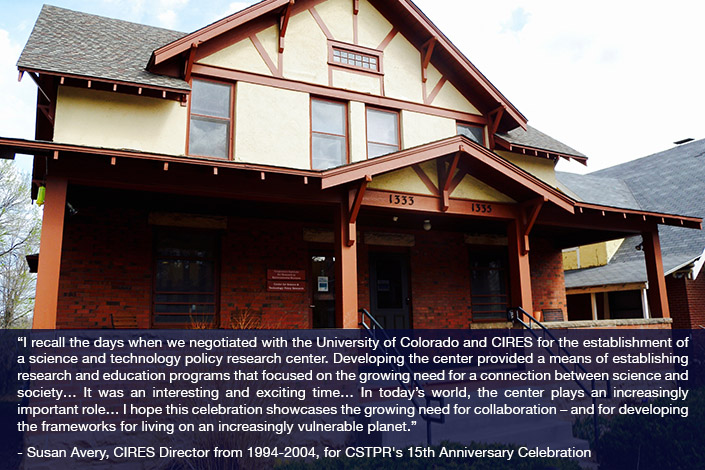
We are housed at the north edge of the University of Colorado campus, at 1333 Grandview Avenue. For directions, click here.
How do I find out about Center activities?
Our homepage includes announcements of upcoming Center events, as well as recent publications and media coverage of the Center. You can also access our newsletter the Ogmius.
If I sign up for your newsletter or briefing will you share my contact information with anyone?
No, we do not share our mailing lists. To sign up on our mailing list click here.
How do I find out more about science and technology policy education?
Contact Max Boykoff at boykoff@colorado.edu. See also our links to S&T-related classes and programs.
How do I find out about science and technology policy-related internships, fellowships, jobs, etc.?
Visit our S&T Jobs page for links to announcements of opportunities in the S&T field. Job openings are also occasionally posted in Ogmius and on the Center’s homepage.
I have a Ph.D. in one of the sciences with no training in science policy. How do I transition to a science policy career without returning to school?
- Apply for a fellowship in Washington, DC-- it's a great way to get your foot in the door for science policy without more school.
- Organizations that offer science policy fellowships for recent Ph.D.s in the sciences (and other fields):
- AAAS Science and Technology Policy Fellowships
- The National Academies Christine Mirzayan Science & Technology Policy Graduate Fellowship Program
- AGU Congressional Science Fellowship
- American Society for Microbiology Congressional Science Fellowship
- American Physical Society Congressional Science Fellowships
- American Chemical Society Public Policy Fellowships
- Current graduate students are eligible for NOAA Sea Grant Fellowships
- Articles:
- Stepping Away From the Bench: Science Policy at the National Academies, by Laura Sheahan
- Science Policy Career Resources, by Laure Haak
- A Matter of Policy, by Brian Vastag
Last updated 10/23/2017



